
The Audience You Already Paid For
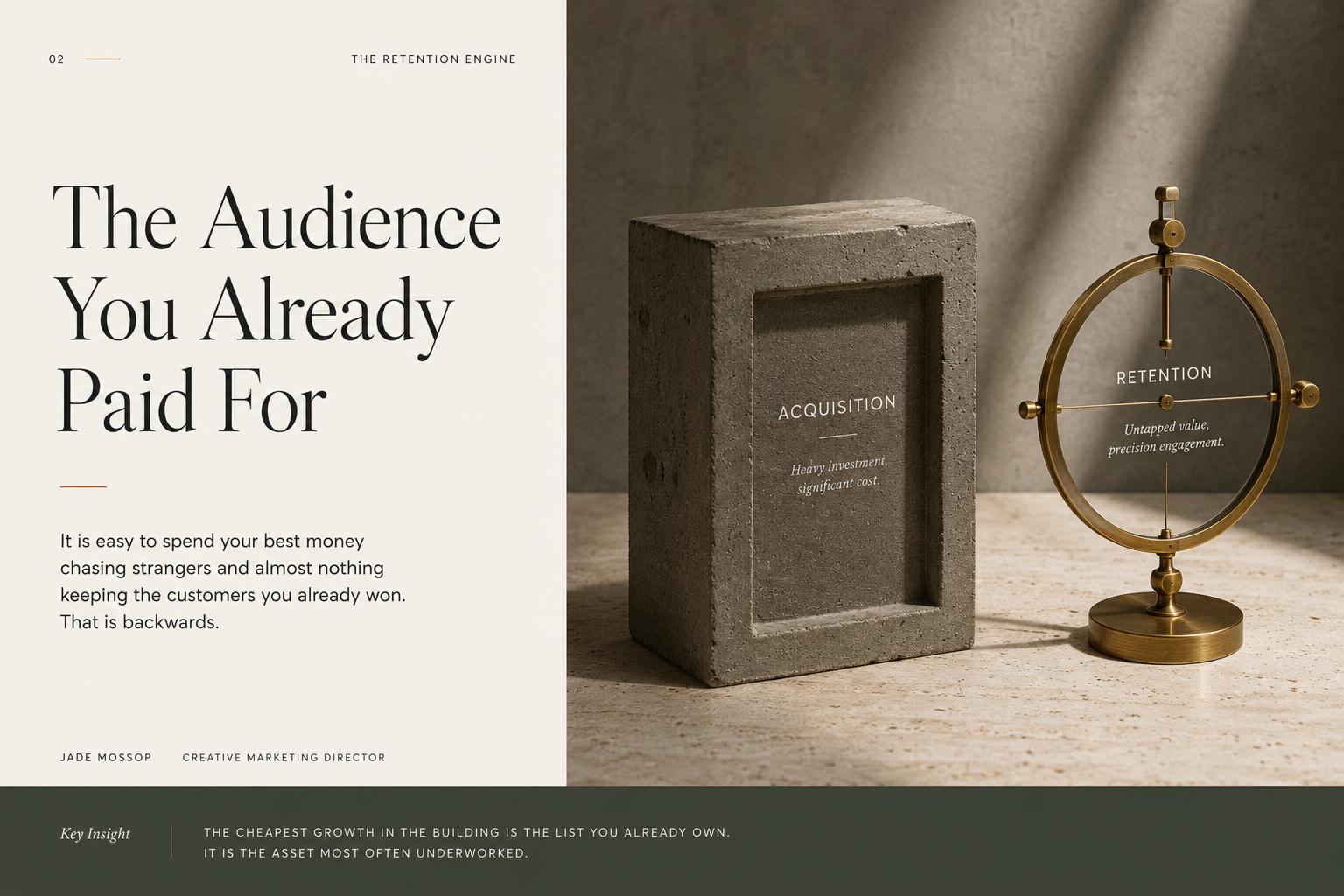
Acquisition gets the budget and the glory. The cheapest growth you have is the customers already on your list. Here is the system that turns that list into revenue.
By Jade Mossop, Global Creative Marketing Director
It is easy to spend your best money chasing strangers and almost nothing keeping the customers you already won. That is backwards. The audience you already paid for is the cheapest growth in the building, and it is the one I see underworked most often.
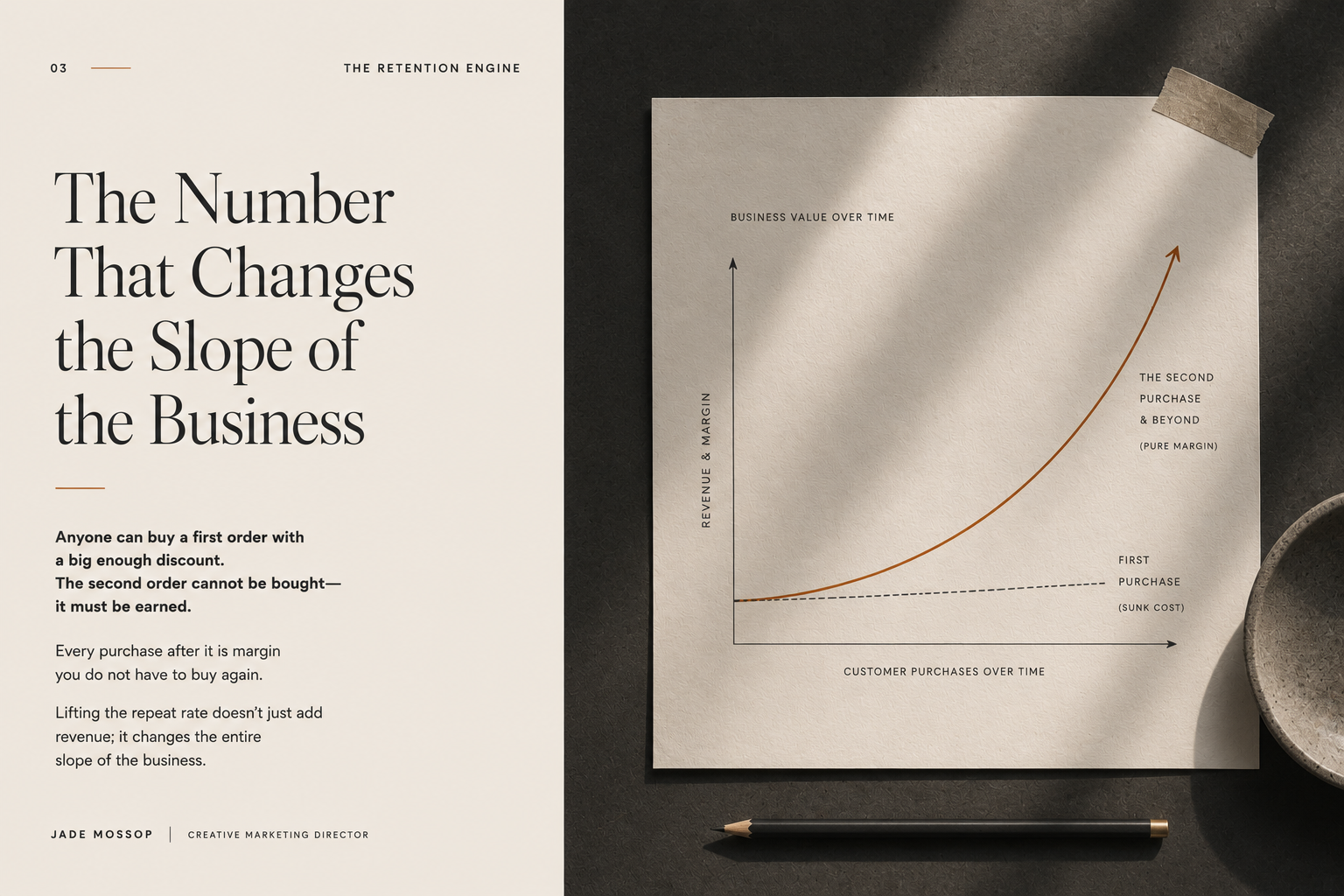
Here is the number that matters most, and the one easiest to overlook: the second purchase. Anyone can buy a first order with a big enough discount. The second order cannot be bought. It only happens if the product, the unboxing, and the brand were good enough to earn it. The repeat rate is the most honest number a brand owns.
And it compounds. A first purchase is a cost you have already paid. Every purchase after it is margin you do not have to buy again. Lift repeat rate a few points and you have not added a few points of revenue, you have changed the slope of the whole business.
The problem is that CRM goes lifeless the moment it gets treated as a discount pipe. A markdown email every week or so, sent to the whole list, forever. That is not a relationship. That is nagging with a coupon. The fix is not more emails. It is a system that sends the right message to the right person at the right moment in their relationship with the brand. Here is how I build that.
First, stop treating your list as one audience
The CRM mistake I see most often is blasting the same message to the whole list. A list is not one audience. It is at least five, and each one needs a different message and a different ask.
The lifecycle taxonomy I use breaks the list into five stages:
The subscriber who has never bought. The goal here is the first purchase. Welcome content, education, an introductory reason to try.
The one-time buyer. The goal is the second purchase. In my experience this is the most valuable and most frequently neglected segment. Replenishment prompts, social proof, product education that deepens the reason to come back.
The repeat buyer, two to four orders in. The goal is loyalty. Subscription upsell, cross-sell, the messaging that turns a habit into an identity.
The VIP, five or more orders or high lifetime value. The goal is to protect and reward. Early access, exclusive content, genuine VIP treatment, not another generic discount.
The lapsed customer, no purchase in 90 days or more. The goal is winback, handled in tiers, which I will come to.
A repeat buyer who receives a welcome email loses trust. A new subscriber who receives a loyalty reward feels tricked. The segmentation is not admin. It is what makes the message land.
Second, split your dormant pool before you touch it
Here is the move I rarely see done. The instinct is to treat every dormant customer identically, as one big "lapsed" segment that either gets ignored or gets the same winback blast. But a lapsed customer who placed four orders is worth far more than a subscriber who never bought at all. Sending them the same message leaves real money on the table.
Split the dormant pool into three before any winback begins:
The lapsed one-time buyer. One order, lapsed 60 to 180 days ago, still engaging with email. A three-email winback: education, then social proof, then a time-limited incentive. The goal is the second purchase that never came.
The lapsed repeat buyer. Two or more orders, lapsed longer, still mailable. A shorter, warmer two-email sequence: acknowledge the relationship, then make a strong offer. This is a higher-value audience and worth a bigger incentive to recover.
The unengaged subscriber. No purchase, no engagement in 90 days or more. A single sunset email. If there is no response, suppress them. Continuing to send to people who never open costs you deliverability and teaches the inbox providers to distrust you.
Third, build the flows that work while you sleep
Campaigns go to a list on a date. Flows go to a person at a moment. The moment is what makes them convert. The flows that earn the most are not complicated, they are correctly timed.
The welcome series sets the relationship. It is not the place for a discount on email one. It is the place to establish what the brand is and why it is worth caring about, and to close on the habit, your subscribe and save or reorder path, once the case is made.
The post-purchase flow is one of the most underused touchpoints I see when I review a brand. The customer who just bought is the most receptive audience you have. Confirm the order, set the shipping expectation, then, timed before they run out, prompt the replenishment and introduce the subscription as the easy way to keep the habit.
The winback flow follows one rule that matters more than any other: lead with the habit and the why, and hold the offer to the end. Do not open with a discount. Open by reminding them what they are missing, prove it with real voices and real quality, and only bring the incentive in at the fourth touch, AOV-gated so it never costs you margin. We do not buy them back. We remind them why they stayed.
The principle underneath all of it
CRM is a creative channel, not a discount channel. It is the one place you have a customer's attention after the sale, with no algorithm taxing the reach and no competitor one click away. The real test of a brand is whether you have anything worth saying once the money has changed hands. When you do, and when you say it to the right segment at the right moment, you own a channel that otherwise sits idle.
And one discipline holds across every email in every flow: one email, one job, one button. The sends that underperform are the ones trying to introduce the brand, showcase a product, offer a discount, and request a review all at once. The reader does not know what to do, so they do nothing.
The move for you: this week, do two things. Split your list into the five lifecycle stages, even roughly. Then split your dormant pool into the three groups above. There is a good chance you will find a lapsed repeat-buyer segment receiving either nothing or the same generic blast as the rest of the list. That segment is the highest-value, lowest-cost revenue available to you right now. Build one winback flow for it, lead with the habit, hold the offer to the end, and you will have turned a dormant cost back into margin without buying a single new customer.
The brands that win the decade will not be the ones who acquired the most. They will be the ones who kept the most.
